



In the first few years of life, more than one million new neural connections are formed every second, according to the Center on the Developing Child at Harvard. The human brain doubles to 70% of adult size during the first year of life, 80% of adult size by age three and 90% by age five. During these critical stages when their brains are developing most rapidly, the stimulation children receive through everyday interactions has a significant impact on their brain architecture and can have lifelong effects on their social, emotional and intellectual well-being. It’s important for children to have safe, supportive developmental environments starting from birth — that’s where The Basics comes in.
The Basics is a national network of communities dedicated to ensuring infants, toddlers and preschoolers of all racial, ethnic and socioeconomic backgrounds are on track to achieve their full potential. By sharing and reinforcing The Basics Principles, health care providers can help families understand brain development in a clear and straightforward way, empower families to implement simple strategies into their everyday routines, and strengthen the parent-child bond.
The Basics offers community partners, family physicians and healthcare providers simple, effective tools for promoting brain development that they can easily share with parents and caregivers.
What Are The Basics Principles?
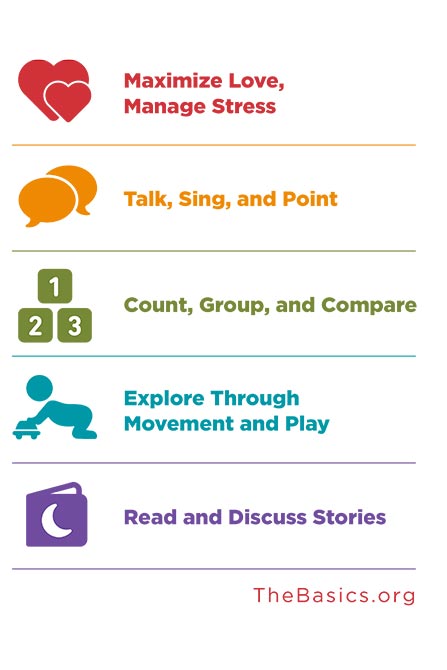
The Basics strategy is based on the understanding that school readiness begins long before preschool, and that families are a child’s first and most important teachers. Centered around five core principles, The Basics provides evidence-based, culturally flexible strategies that align with a baby or toddler’s social, emotional and cognitive development from 0-12 months, 12-36 months and 36-60 months. The Basics Principles were developed by scientists and early childhood experts at The Achievement Gap Initiative (AGI) at Harvard University based on decades of research.
Each principle emphasizes a different aspect of development, including social-emotional, language and literacy, cognition and general knowledge, physical development and well-being, and receptive approaches to learning. The Basics Principles aren’t new strategies parents have never heard of; rather, they name and provide shared language for what parents are already doing or can easily do more intentionally once they understand why it matters.
Maximize Love, Manage Stress
Staying emotionally present for your child increases their happiness, strengthens their emotional health and builds self-control skills. Infants and toddlers thrive when their environment feels loving, safe and predictable. Families create this environment by expressing love through simple things like holding, kissing and cuddling their child, and offering frequent words of encouragement.
This principle also emphasizes the importance of parents taking care of themselves to best show up for their child. Parenting can be stressful and overwhelming, and parents’ emotions impact those of the child. Maximize Love, Manage Stress provides strategies for adults to help cope with stress to stay calm and patient with their children. Modeling this behavior can help children learn how to deal with and overcome moments of stress themselves.
Talk, Sing and Point
Boost your child’s language skills and knowledge of the world. Children begin to learn language very early by paying attention to our sounds and expressions when we interact with them. Talk, Sing and Point focuses on nurturing children’s communication development using strategies such as maintaining eye contact, taking turns and responding to the child’s sounds with words and facial expressions.
Engaging in simple activities like naming body parts and objects, talking through the steps involved in your daily tasks, and asking and answering questions about things that interest them teaches children about the world and helps lay the foundation for critical language and communication skills later in life.
Count, Group and Compare
Help your child make sense of the numbers and categories all around them. It’s never too early for families to introduce simple math concepts to babies and toddlers, such as noticing amounts and patterns, and comparing sizes and shapes. Count, Group and Compare emphasizes the ways children can learn math as they play and talk during everyday moments, building on their natural skills and boosting their confidence.
Simple activities like counting and wiggling each of their toes, filling a container with water in the bathtub and dumping it out again, and stacking blocks all help children begin to make sense of the world and build the foundation for math long before they enter school.
Explore Through Movement and Play
Encourage curiosity, discovery, and a healthy body. Children benefit from spending time playing with others and time playing alone, figuring things out independently (with parents nearby). Explore Through Movement and Play emphasizes building coordination and strength while exploring and learning about the world.
Families can help their children explore the five senses by providing objects with different colors, shapes, sounds and textures. Engaging in different types of play, such as imaginative and pretend play, creative activities such as drawing, and physical play, such as crawling or rolling a ball, helps children build on their curiosity and excitement to learn about the world around them.
Read and Discuss Stories
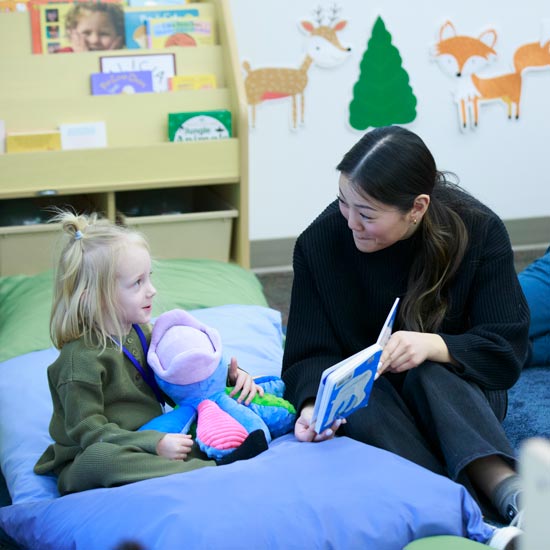
Build your child’s knowledge, reasoning and early literacy skills. Reading aloud to children is one of the most important things we can do to prepare them to do well in school. Read and Discuss Stories focuses on how families can help children build language skills, spark imagination and build connections by reading together.
Strategies such as describing the pictures, asking questions about the story and using different voices and facial expressions to add interest to the story all help to engage children and make reading fun. Encouraging families to read with their child regularly will boost early literacy skills and foster a lifelong love of learning.
How Physicians Can Integrate the Basics
Family physicians and pediatricians are often the only professionals who see children and parents consistently during the first few years of critical brain development. Incorporating strategies and sharing resources from The Basics during these visits equips families with knowledge and tools that shape brain architecture, promote healthier outcomes, and lay the foundation for future school readiness and educational attainment.
Importantly, The Basics does not replace clinical advice; it simply enhances the impact of every interaction with families. Physicians can easily integrate The Basics strategies, even when appointment time with families is limited. It doesn’t require additional cost, time or special equipment. The Basics works because it can be woven into what physicians already do.
Rather than approaching The Basics as an additional task or separate discussion, clinicians can model The Basics during visits, use the language when it fits and connect conversations back to The Basics Principles. For example, when a parent says they’ve noticed their child has started babbling, you can make the connection: “That’s part of talking, singing and pointing — one of The Basics Principles that help build brain development.”
This approach frames The Basics not simply as parenting advice, but as evidence-based strategies for promoting their child’s brain development. Physicians act as trusted messengers by sharing resources and strategies that parents can start using right away. You can empower families to approach daily interactions and routines with their child with knowledge and intention.
Learn More About The Basics
The Basics Utah is part of a national network of 126 communities across the country, all working to embed The Basics Principles into routine family engagement to promote healthy development, strengthen parent-child relationships, and connect caregivers to resources. Now, The Basics has launched in Utah with community partners who are committed to building The Basics movement so families from every background can benefit from the science of early development and achieve their full potential.
Visit thebasicsut.org to learn more and explore the Community Toolkit to access 100+ free, high-quality materials and resources about The Basics — including digital and printable tip sheets, short parent-friendly videos, simple conversation prompts for clinicians, waiting-room and exam-room materials, and more.