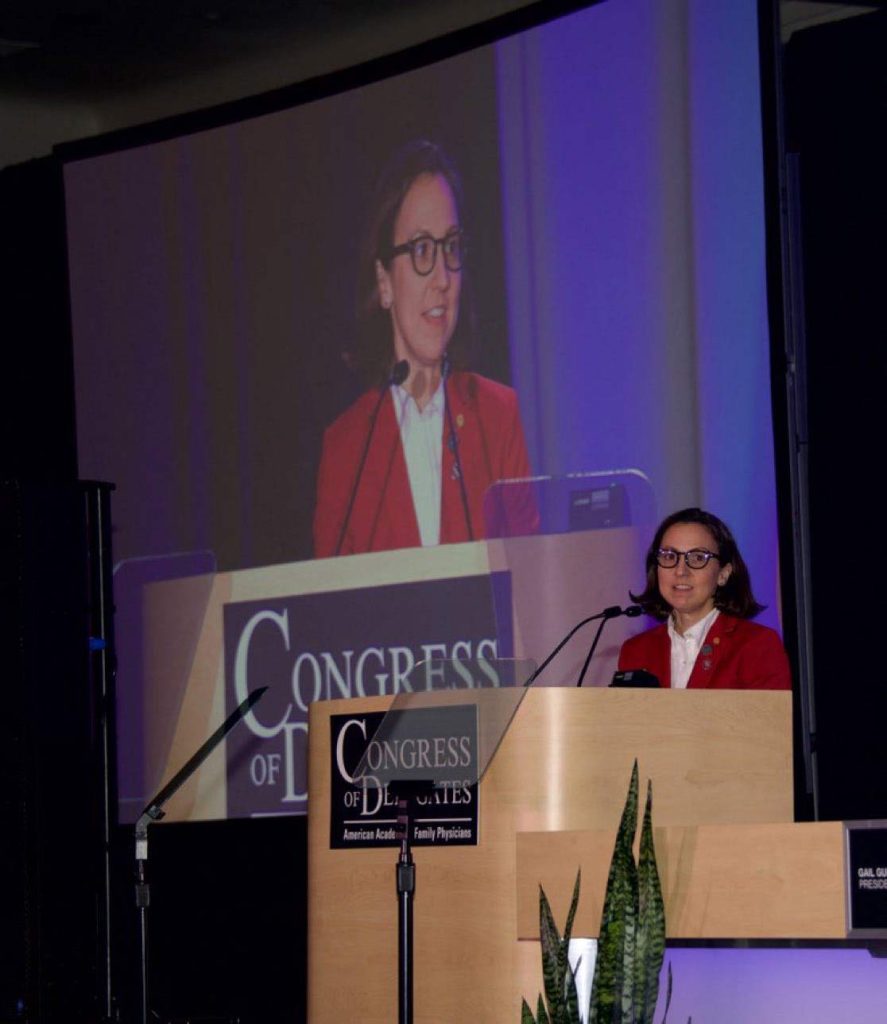


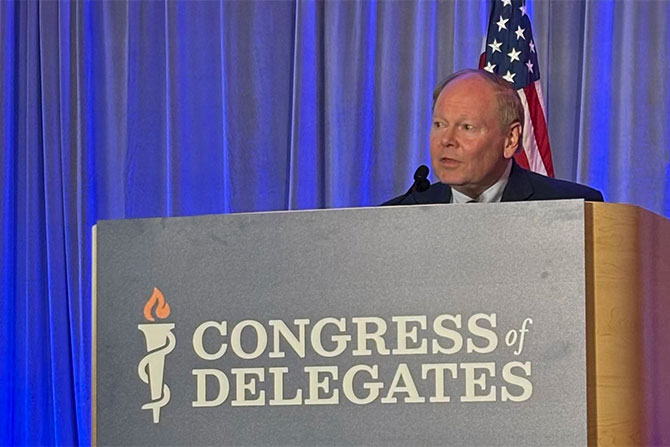

Feature image: Outgoing AAFP President Dr. Steven Furr addresses the Congress.
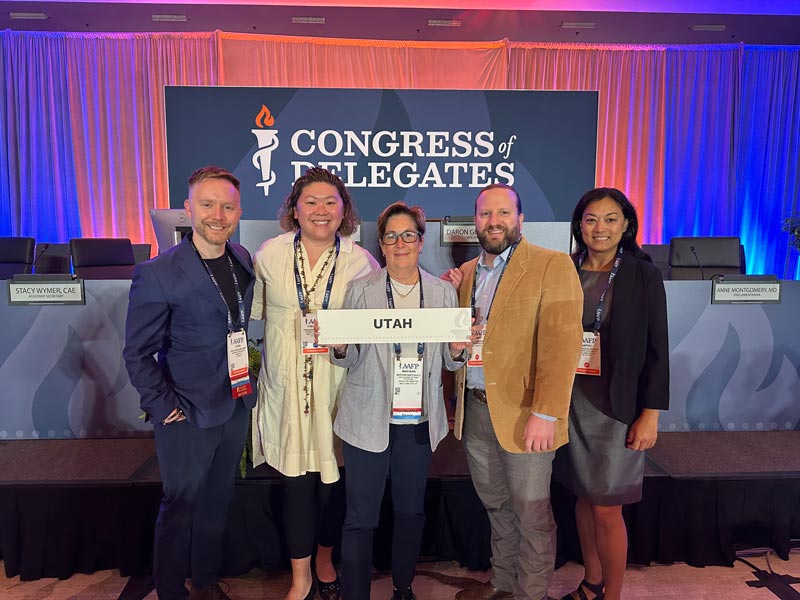
It was another great year at the annual AAFP Congress of Delegates (COD). UAFP members are always well-represented by their elected representatives, and this year’s delegates were no exception. This year’s congress was held Oct. 4-6 in Anaheim, California.
UAFP presented two resolutions, both of which were passed by the delegates.
Resolution 1: Addressing Health Misinformation in Primary Care to Support Clinician Well-Being and Patient Trust
This resolution instructs AAFP to develop and disseminate evidence-based training modules and communication resources to assist family physicians in effectively and efficiently addressing health misinformation during clinical encounters, with the goal of preserving trust, improving patient outcomes, delivering evidence-based care and reducing clinician stress and burnout.
Resolution 2: HIPAA Protection for Immigration Status
This resolution directs AAFP to advocate for the recognition of immigration status as PHI, not to be disclosed without the expressed consent of patients.
For those wishing to get involved, delegate elections are held each year in the spring, and delegates are elected for a two-year term. The 2026 Congress will be held in Nashville, and the 2027 Congress will be held in San Diego.
View the complete list of 2025 Congress of Delegates Resolutions, UAFP positions and final results.
Perspectives from Utah’s Delegates
Nick Duncan, MD, UAFP Alternate Delegate
“I am tired of being educated about fire safety by arsonists!”
The metaphorical phrase spoken by AAFP CEO Shawn Martin capitalized on the momentum building throughout his address to the 2025 COD. It was the phrase that captured my attention the most as I attended the Congress a few weeks ago. (I’ll let you guess as to what he was referring to.)
We are living through turbulent times, to say the least, in the healthcare landscape. Systems we have relied on — and that much of the world has also relied on — for decades are being dismantled or attacked. Uncertainty is felt everywhere, especially by our patients.
And yet, despite the turbulence, throughout this Congress, there was a clear sense that we are uniquely positioned to continue educating our patients individually with evidence-based guidance and fight collectively on a larger scale to push back against the misinformation flooding the country.
Dozens of resolutions were debated, reworded and reorganized, and many eventually passed, providing clear direction for the Academy to stand strong for our profession and our patients in this difficult landscape. As a delegation, it was heartening to see the two resolutions we put forth pass, again with strong emphasis on supporting us as we care for our patients.
While I did not write down quotes from others who spoke during the Congress, I walked away with great confidence in our national leaders. The newly sworn-in president, Dr. Sarah Nosal, and the newly elected president-elect, Dr. Kisha Davis, both bring extensive experience and drive to lead us through the turmoil. I wholeheartedly support them as they stand firm for us and our patients on a national level, clearly proud to be family physicians. I, too, am proud to be a family physician.
Thank you for the opportunity I have been given over the last two years to represent Utah at the AAFP COD. It has been an honor and a privilege.
Chad Spain, MD, FAAFP, UAFP Delegate
I’ve yet to come away from an AAFP event without feeling rejuvenated, and this year’s COD was no different. With a clearly unprecedented year of combating science against the current leadership of HHS, Shawn Martin (CEO of AAFP) let it be known that the Academy will continue to fight for the health of our patients and our rights to practice as physicians. Incoming president Sarah Nosal, MD, FAAFP, and new president-elect Kisha Davis, MD, MPH, FAAFP, gave passionate speeches as well, ensuring the leadership of the academy is in great hands for years to come. Our delegation was able to pass both resolutions we submitted this year, including one to help physicians combat medical misinformation.
For those of you who may feel isolated, helpless or defeated in your quest to deliver healthcare in an effective model for both you and your patients, know that you’re not alone. After speaking with our colleagues across the nation, it’s clear that we all face similar barriers from external forces. The AAFP hears your voice and is working diligently to improve your life and our healthcare system. It’s been an honor to serve in Utah’s delegation; we trust that the work at COD will establish a framework to improve your clinical practice and lives in the immediate future.
Thea Sakata, MD, UAFP Delegate
Today is a great day to be a family physician! At first, this may seem like a strange thing to say. Avedis Donabedian, the grandfather of health services research, theorized that structures underpin processes that beget outcomes. As we see many structural foundations of science and medicine dismantled around us, the future looks grim for many processes and outcomes to which our profession has become accustomed. But out of crisis rises opportunity, and if we family docs want things to change, now is a tantalizing moment to engineer it.
That work was well displayed at this year’s AAFP COD in Anaheim, California. Two reflections on this year’s Congress come to mind. First, the energy in the room was different than when I was a delegate for our state two years ago. While there was always a sense that the work of the COD was important, this year it held more gravity and urgency than before.
As part of the usual opening rounds of business, Speaker Russell Kohl of Missouri called for any late resolutions to be presented. Because they have not undergone the procedural scrutiny of the regular resolution submission process, late resolutions can be an eclectic mix of urgencies and imperfectly reasoned desires. This year was different.
There was only one late resolution brought before the congress: an ask by Dr. Steven Furr, past AAFP president and family doc from Alabama, to include healthcare work as an independent risk factor for infectious diseases due to repeated pathogen exposures, thus allowing healthcare personnel without other conditions to have access to any available immunizations, personal protective equipment and pre/post exposure prophylaxis. In a year when writing prescriptions for COVID shots took up greater than zero hours of physician time, I not only appreciated the spirit of Dr. Furr’s resolution, but also how it highlighted that organizations matter. When healthcare workers are facing barriers to their own safety, a policy statement from a major national physicians’ organization, such as the AAFP, can help them push back.
The second reflection that made an impression is that if we physicians want the healthcare system to change in a way that supports our patients’ health and our role therein, using our professional societies to get there makes good sense. Management strategist and Harvard Business School professor John Kotter famously outlined an eight-step model for episodic change management. (See Miles et al., 2023, PMID 36817526, for an accessible description of the model and how a GME program utilized it for candidate recruitment.) I’ve listed the first four steps below, along with how current events and the AAFP’s existing infrastructure already put us halfway to major change.
The First Four Steps of Kotter’s Model for Change Management
- Create a Sense of Urgency: Current events have already done this.
- Build a Guiding Coalition: The AAFP’s leadership and influential groups.
- Form a Strategic Vision: The work of the AAFP COD.
- Enlist a Volunteer Army: All of us as the membership of the AAFP.
The remaining four steps — enable action by removing barriers, generate short-term wins, sustain acceleration and institute change — are still works in progress. However, if we want a future healthcare system that works for us rather than against us, family physicians are well-positioned to drive that change. I can’t wait to see what next year’s COD brings. What a great time to be a family physician!
Saphu Pradhan, MD, FAAFP, UAFP Alternate Delegate
Throughout my years of involvement with the AAFP in various roles, I have considered it a privilege to be among the most passionate family physicians in the country, discussing important issues facing our profession, our patients and the communities we serve. I have trusted the AAFP to stand behind science, defend our scope of practice and take an objective approach on charged issues to accomplish our shared goal of providing holistic care.
In past years, the camaraderie between diverse-minded colleagues and our ability to reach an agreement on various issues were matters of conversation and mutual understanding. However, this year, I was skeptical of finding common ground as topics that were previously taken for granted have now become controversial. I was anticipating a COD meeting with vaguely worded speeches that would tread lightly on those issues, and expected that the delegates and alternate delegates would assume divisive positions.
Surprisingly, the speeches were quite open and direct, recognizing that we are living in a dynamic era and our ability to care for patients has been overshadowed by fears that were previously not a threat. The progress we have made over decades of hard work to serve all populations in this vast nation is being reversed, further limiting access to healthcare and our ability to provide it.
Family medicine relies on our ability to establish trust and build relationships with the human beings we serve; to develop an understanding of their values and beliefs; to take into consideration the issues they face in daily life that may interfere with their ability to access appropriate and adequate care; to take into account their mental health as a significant part of their overall state of health and wellbeing; and to guide them through the scientific basis of their diagnosis and management of their conditions. Our practices are now limited regarding which human beings we may serve, who may receive our services, what kind of services we may provide, which services are unavailable, who can afford care and the extent of the care we may provide within these boundaries. The obstacles we are facing seem vast and insurmountable.
Once again, the assembly of national leaders and state representatives that participated in the COD meeting brought reassurance, reinforcing that we are not alone and we are not helpless. State chapters, including ours, remain united with a common purpose. National leaders are working with other healthcare organizations to address each challenge and develop creative strategies to provide evidence-based, high-quality care to the human beings we call patients. I hope all Utah family physicians can find support and understanding in this organization. Thank you for the opportunity to serve as your alternate delegate.